Walk into any outdoor umbrella living store, and you will likely notice the same puzzle: two patio umbrellas that look nearly identical, yet their price tags tell a completely different story. Some say it is brand markup, others blame clever marketing. But anyone who truly understands outdoor furniture will tell you that the real reasons run much deeper than what meets the eye.
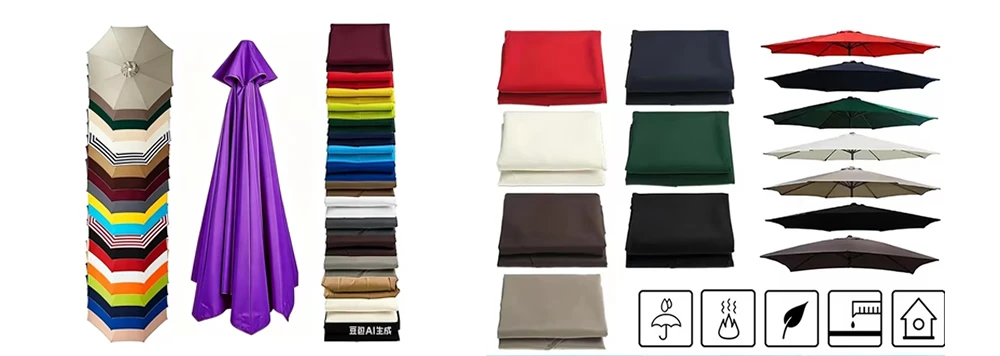
Fabric is the most visible part of a patio umbrella, yet it is also the most overlooked cost driver. Polyester (woven polyester fabric) dominates the market, but even among polyester options, different fabric weights and finishing processes create surprisingly large price gaps.
Fabric weight determines thickness and durability. A standard patio umbrella typically uses fabric weighing between 180 grams and 300 grams per square meter. The higher the weight, the thicker the material, and the better its tear resistance and light-blocking performance. For example, 230g polyester is considered entry-level, while 280g or even 300g high-weight fabrics cost significantly more to produce. This is exactly why some umbrellas feel stiff and substantial, while others turn flimsy and wrinkle-prone – the latter usually have much lower fabric weights.
The dyeing process is where the real cost divide happens. Currently, patio umbrella fabrics are colored using two primary methods: pigment printing and solution dyeing. Pigment-printed fabric has color applied only to the surface layer. It looks vivid at first, but fades quickly under strong UV exposure – often becoming patchy and worn after just one summer. Solution-dyed fabric, on the other hand, has pigment infused deep into each polyester fiber during the manufacturing stage. The color penetration is thorough, making it far more resistant to sunlight, rain, and repeated folding. This durability comes at a much higher production cost, which is why premium patio umbrellas almost always use solution-dyed materials, often with accelerated weathering tests to guarantee 3 to 5 years of color retention under intense sun.
Beyond coloring, UV protection treatments also add to the bill. Standard polyester blocks some ultraviolet rays, but reaching UPF 50+ rating (blocking over 98% of UVA/UVB) requires either specialized coatings or high-density weaving techniques – both of which push the final price upward.
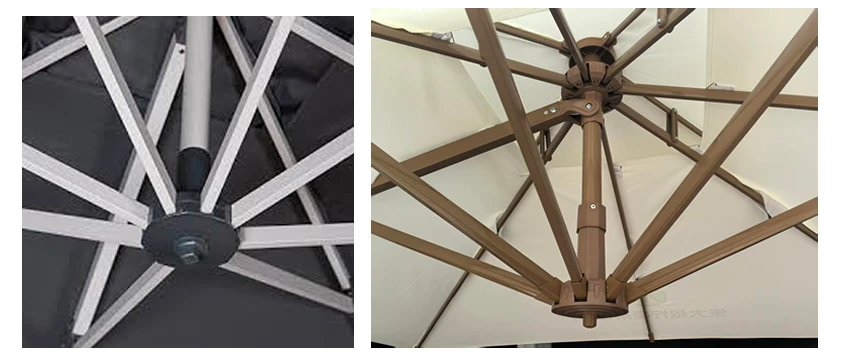
If fabric is the face of a patio umbrella, then the frame is its backbone – and this is where many budget umbrellas cut the most corners.
Material choice: iron vs aluminum. For umbrella poles and ribs, the market basically offers two options: iron and aluminum. Iron frames are the cheapest to manufacture, but they have one fatal flaw – rust. Once the spray-painted or baked-enamel surface gets scratched, chipped, or simply worn down by sun and rain, corrosion starts from the inside out, eventually causing the ribs or central pole to snap. Aluminum frames, in contrast, never rust, and they weigh considerably less, making the umbrella easier to move, tilt, and store. Higher-grade aluminum alloys, such as 6061-T6 or 6063-T5, undergo heat treatment to achieve strength that actually surpasses ordinary iron tubing, delivering much better wind resistance. Be cautious of suspiciously cheap umbrellas that claim to be aluminum but are actually iron with a silver coating – a simple magnet test will tell the truth, since iron is magnetic and aluminum is not.
Pole thickness directly affects strength and stability. Even with the same aluminum material, a center pole of 38mm diameter performs very differently from one of 48mm. Thicker poles handle higher wind loads, reduce wobbling, and support larger canopies without bending. Some premium models go up to 58mm poles, sometimes with octagonal cross-sections for added rigidity. The thickness of the ribs, the quality of joint rivets, and whether connectors are anti-corrosion treated also contribute to both manufacturing cost and long-term reliability.
Real-world usage tests show that standard aluminum-frame patio umbrellas may develop slight deformations after 2 to 3 years of regular outdoor exposure, while high-grade aircraft-aluminum frames remain structurally sound after 5 years under identical conditions. That durability gap comes directly from material quality and processing precision – not from brand logos.
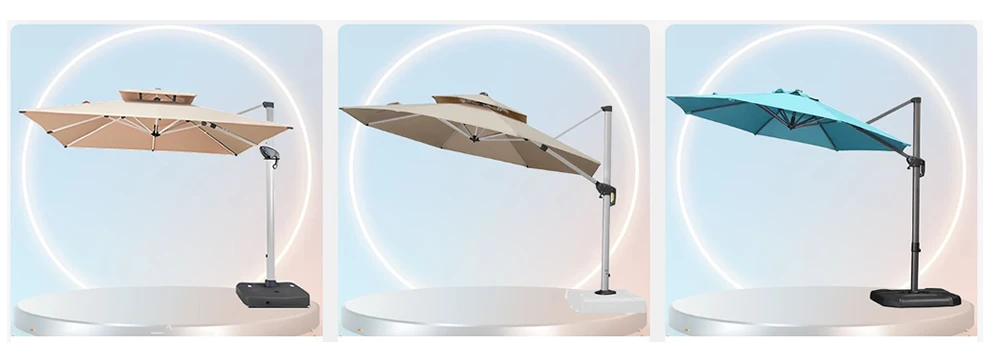
Many shoppers assume that a slightly larger umbrella simply uses a bit more fabric, so the price increase should be modest. In reality, this assumption could not be more wrong.
Both material volume and structural reinforcement must scale up. Moving from a 2.4-meter canopy to a 3-meter one increases the fabric area by roughly 56%. But more importantly, a larger canopy catches significantly more wind, which means the entire frame – ribs, center pole, connectors, and even the base – must be strengthened proportionally. A 3-meter umbrella in real-world midday conditions provides about 35% more effective shade coverage than a 2.4-meter model, comfortably covering a four-person dining set with two lounge chairs, whereas a smaller umbrella often only shields the tabletop, leaving occupants exposed as soon as they lean back.
Larger umbrellas also demand more complex opening mechanisms, heavier counterweights (some requiring 30kg or more bases), and often reinforced tilt systems to handle the extra leverage. All these engineering upgrades push costs up at a faster rate than the canopy size alone would suggest.
Practical buying advice: Instead of being drawn by the lowest sticker price, consider the long-term value. A cheap iron-frame umbrella with pigment-printed fabric that falls apart after two seasons, versus a more expensive aluminum-frame, solution-dyed umbrella that serves you well for five years or more – which one actually saves you money? When shopping, focus on the specifications that truly matter: fabric weight in grams, dyeing process (solution-dyed vs pigment-printed), frame material (aluminum vs iron), pole diameter in millimeters, and base weight. These are the real indicators of what your patio umbrella is actually worth.